


Harold Schiffman´s Photo Gallery
|
|
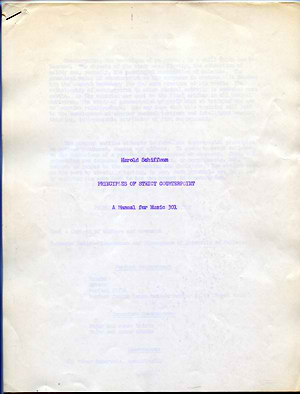
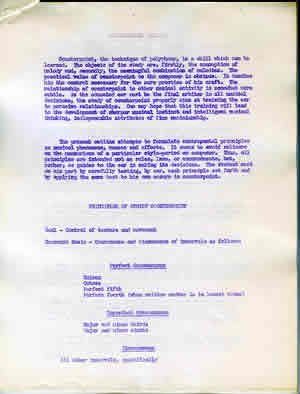
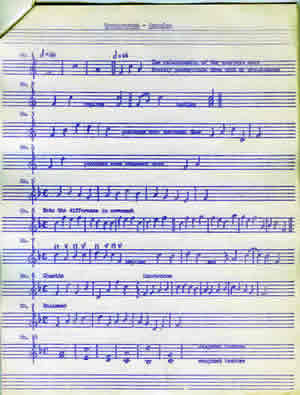
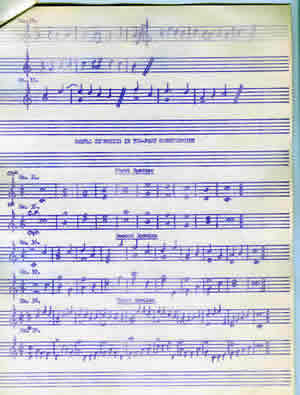
Photographs Relative to Other ActivitiesPrinciples of Strict CounterpointHarold Schiffman's early classes teaching strict counterpoint* ("sixteenth-century counterpoint") -- an undergraduate Junior-level course -- led him to create a manual describing the principles that guide that compositional procedure. It was compiled at his students' request, and duplicated and distributed at no cost to them. The reward to the author was the knowledge, skill, and appreciation of the subject that his efforts engendered in those students. *Harold Schiffman taught composition and music theory in the School of Music [now College of Music], The Florida State University, Tallahassee
between 1958 and 1984.
Harold Schiffman's Commencement Address: University of North Carolina
|
||||||||||||||||||||||||||||||||||||||||||||||||||||||||||||||||||||||||||||||||||||||||||||||||||||||||||||||||||||||||||
|
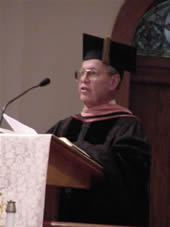
Commencement Address to the Graduates of the School of Music, The University of North Carolina at Greensboro, presented by Harold Schiffman. West Market Street United Methodist Church, Greensboro, North Carolina (14 May 2004) |
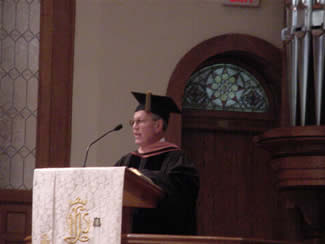 |
| Harold Schiffman presenting the
Commencement Address to the Graduates of the School of Music, The University of North Carolina at Greensboro. (14 May 2004) |
 |
University of North Carolina at Greensboro
School of Music National Advisory Board, 2000 – 2006;
Chairman, 2002 – 2004
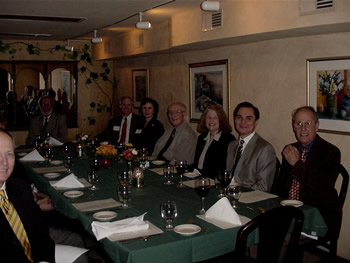 |
National Advisory Board (Harold Schiffman, Chairman 2002 – 2004), School of Music, UNCG: Board Dinner. Greensboro, North Carolina (9 November 2002) |
|
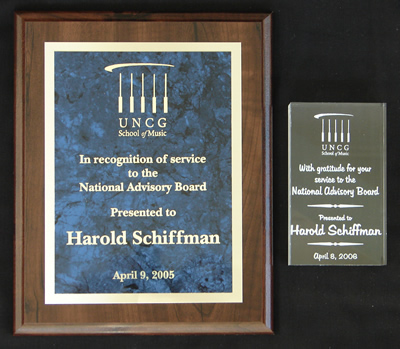
(L) Plaque recognizing Harold Schiffman's service to the National Advisory Board of the School of Music,
University of North Carolina at Greensboro (Presented 9 April 2005) (R) Etched trophy of gratitude for Harold Schiffman's service to the National Advisory Board of the School of Music, University of North Carolina at Greensboro (Presented 8 April 2006) |
 |
Southeastern Composers League
 |
Certificate of Recognition to Harold Schiffman for "his outstanding contribution to the establishment and development of the Southeastern Composers League and the Art of Music" Dated 6 April 2001 |
Banjo
Harold Schiffman indulges his lifelong love of the banjo, picking bluegrass with Bill and Wilma Millsaps and, more recently, developing an interest in clawhammer (sometimes called frailing or stroke-style) banjo.
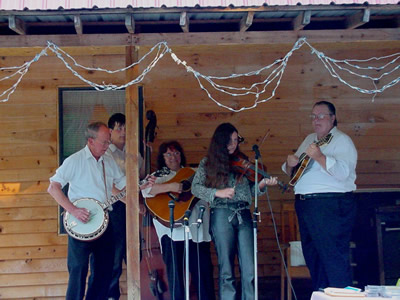 |
Harold Schiffman playing with Bill and Wilma Millsaps and the Snowbird Mountain Band at the opening of
new restaurant, in Reliance, Tennessee. (L to R) Harold Schiffman (banjo), Stephen Millsaps (bass); Wilma Millsaps (guitar); Abigail Moore (fiddle); Bill Millsaps (mandolin) (25 August 2001) |
|
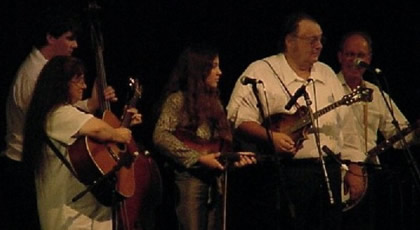
The Snowbird Mountain Band on stage at the Smoky Mountain Folk Festival at Lake Junaluska, North Carolina.
(L-R) Wilma Millsaps on guitar; Stephen Millsaps on bass; Abigail Moore on fiddle; Bill Millsaps on mandolin;
Harold Schiffman on banjo. (31 August 2001) |
 |
|
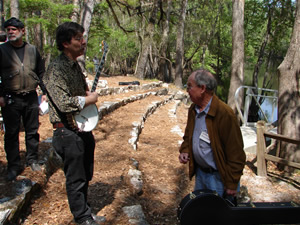
Harold Schiffman with banjoist Ken Perlman. Suwannee Banjo Camp, O´Leno State Park, Florida (19 March 2006) |
 |
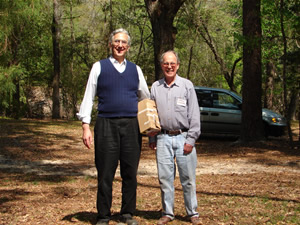 |
Harold Schiffman with folk fiddler and archivist Alan Jabbour. Suwannee Banjo Camp, O´Leno State Park, Florida (19 March 2006) |
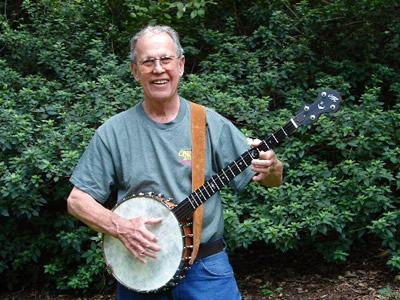
| OME, Sweet OME!
“Harl” with his 2005 Christmas present: an OME Jubilee Deluxe open back banjo (and OME tee-shirt to match!) |
 |
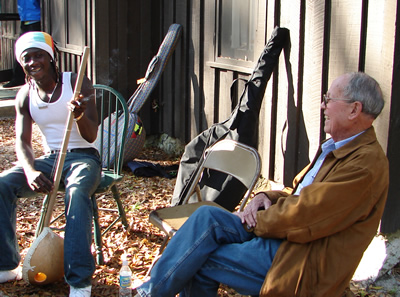 |
Sana Ndiaye and Harold Schiffman with an ekonting Suwannee Banjo Camp, O´Leno State Park, Florida (23 March 2008) |
SUWANNEE BANJO CAMP, 20–22 MARCH 2009: ANOTHER GREAT EVENT!
The sounds of the banjo – clawhammer, stroke style, frailing, bluegrass, AND clawgrass – rang through the woods bedecked in dogwood blooms and wild azalea flowers to rival the best efforts of Florida's O'Leno State Park's full and beautiful complement of birds. It was time for this year's Suwannee Banjo Camp, to the enjoyment and instruction of all. From rank beginners to the giants of the banjo world – and add some fiddlers, guitarists, and mandolin players for good measure – everyone thrived. As did the music, a home-bred style that invades each tapping foot, and feeds the means of communicating through symphonic musical expressions as well. So if one is touched by the friendliness of Harold Schiffman's music, it is not surprising. The sound of people making music for people is right there, as it is in the annual Suwannee Banjo Camp.
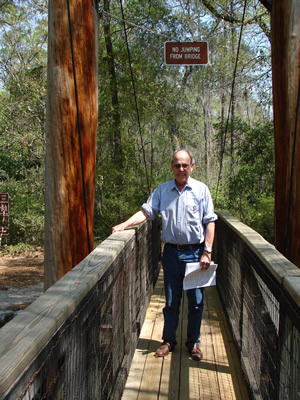 |
Harold Schiffman, having arrived at the 2009 Suwannee Banjo Camp, walks across the Santa Fe River and cheerfully
obeys the bridge's sign: "NO JUMPING FROM BRIDGE." Suwannee Banjo Camp, O'Leno State Park, Florida (20 March 2009) |
|
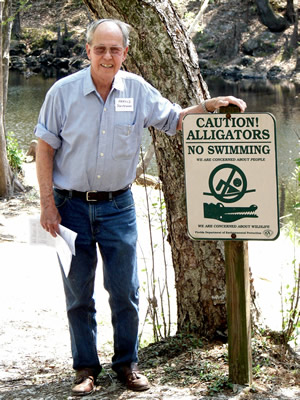
Harold Schiffman, strolling along the Santa Fe River bank, likewise cheerfully obeys this sign: "CAUTION! ALLIGATORS -- NO SWIMMING." Suwannee Banjo Camp, O'Leno State Park, Florida (20 March 2009) |
 |
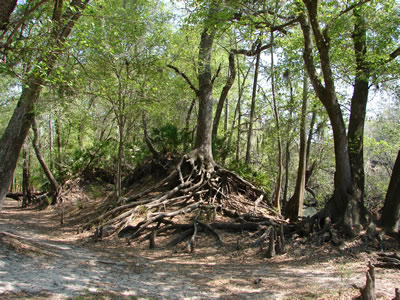 |
As music has roots, and people have roots, so do trees, yet none grander than these on the bank of the Santa Fe River. Suwannee Banjo Camp, O'Leno State Park, Florida (20 March 2009) |
|
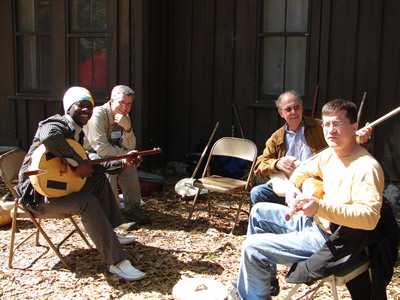
"African Roots," one of the Suwannee Banjo Camp's course sequences, offers ekonting classes such as this one. (L to R) Sana Ndiaye (SBC faculty member, with his large ekonting), SBC faculty member Greg Adams, student and enthusiast Harold Schiffman, SBC faculty member Paul Sedgwick Suwannee Banjo Camp, O'Leno State Park, Florida (21 March 2009) |
 |
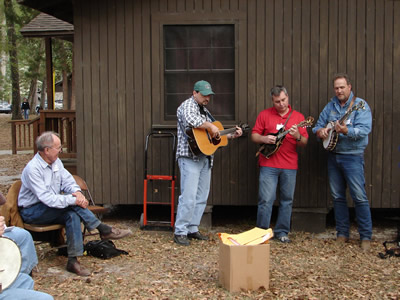 |
Suwannee Banjo Camp's class "Clawhammer Back-Up from Scratch" under the tutelage
of faculty member Mark Johnson, here seen demonstrating what session's name means.
(L to R) Harold Schiffman, student; Danny Smith, guitar; Scott Anderson, mandolin; Mark Johnson, banjo. Suwannee Banjo Camp, O'Leno State Park, Florida (21 March 2009) |
|
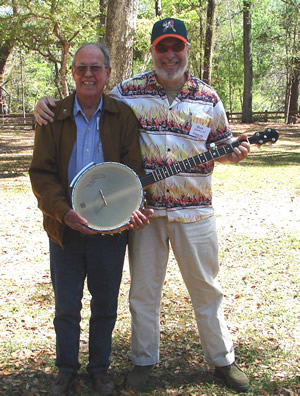
"Going for gold!" Winner of the Suwannee Banjo Camp's silent auction, Harold Schiffman is joined
by SBC faculty member and Gold Tone artist Bob Carlin – with Harold's newly won Gold Tone banjo. Suwannee Banjo Camp, O'Leno State Park, Florida (22 March 2009) |
 |
Budapest and Győr (2007)
|
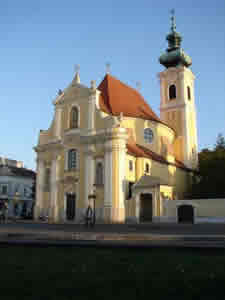
Near both the old city walls and the Cathedral, as well as the rivers Rába and Moson-Danube (Mosoni-Duna) stands the Carmelite Church (Karmelita templom), dating from 1697-1732. Győr, Hungary (20 September 2007) The Carmelite Church (Karmelita templom) (1697-1732) was designed by Carmelite monk Márton Athanáz Wittwer, which design adds an 18th-century grace to the church's square. The square itself (Bécsi kapu tér) is named for the site of the former city gate (kapu) that opened towards Vienna (Bécs) and that was demolished in 1858.§ |
 |
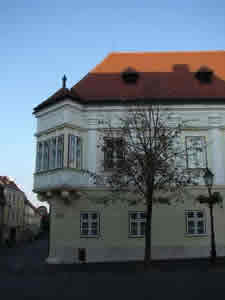 |
The Altabak house (Altabak-ház) faces the square shared with the Carmelite Church. This square (Bécsi kapu tér), with its venerable and graceful houses, reflects Győr's long history as a center of culture. Győr, Hungary (20 September 2007) Around the start of the 18th century, Győr's houses began to feature enclosed corner balconies, such as one sees here. For whatever reason, these enclosed structures could afford the person inside a full 270-degree view of the outside world - perhaps gathering the town's news or circumventing the prohibition of women's venturing outside the home without an escort - thereby allowing the occupants to notice and be noticed by the gentlemen walking outside. The Altabak house (Altabak-ház), seen here, faces the Bécsi kapu tér, and has two such corner balconies, which were 18th-century additions to the original 1620 house (built by Canon János Altabak).§ |
|
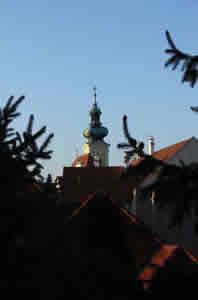
The Carmelite Church's steeple does not stand as high as that of the Cathedral (Bazilika) atop Chapter Hill (Káptalandomb), yet it is readily seen within the inner town of Győr, as well as from Chapter Hill, as it is seen here. Győr, Hungary (21 September 2007) Chapter Hill (Káptalandomb) served as the point which the Roman soldiers had occupied both during Dacian attacks and during the wars between the indigenous Illyrian-Pannonian tribes and the Celts. Parts of its fortifications still remain. This high point was chosen as the site, first for a medieval church, and thereafter for the Cathedral (Bazilika).§ |
 |
||
§ NOTE: Historical data concerning Győr were gathered from various sources, including:
|
|||
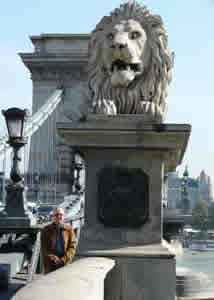 |
Harold Schiffman and a fellow Leo at the East end of the Chain Bridge (Széchenyi Iándhíd) that spans the Danube and joins the formerly separate cities of Buda and Pest. Budapest, Hungary (24 September 2007) |
Budapest and Győr (2008)
|
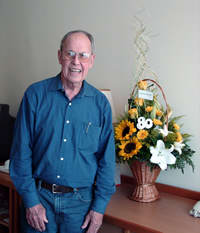
Flower arrangement from the Kiraly Music Network greeting Harold Schiffman upon his arrival in Győr (9 October 2008) |
 |
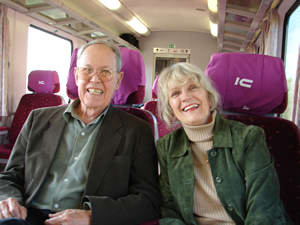 |
Harold Schiffman and Jane Perry-Camp en route from Győr to Budapest via train (18 October 2008) Photograph by Szidónia Juhász |
|
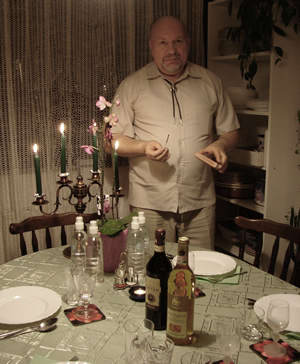
Recording engineer István Biller as gifted chef was amply demonstrated in his special farewell dinner offered in his home. (26 October 2008) |
 |
Hiking
The only hitch to this hiking is that the signs are in the Romansch language of the Swiss Engadin/Engadine (in the southern part of the Graubünden/Grisons canton).
|
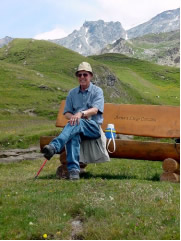
Harold Schiffman . . . taking a break from hiking. Upper Engadine, Switzerland (27 June 2003) |
 |
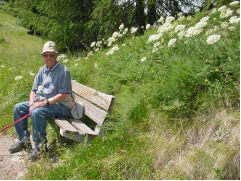 |
Harold Schiffman . . . taking a break from hiking. Upper Engadine, Switzerland (27 June 2003) |
|
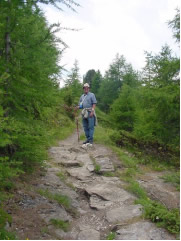
Harold Schiffman pausing during a climb in the Swiss Alps. Upper Engadine, Switzerland (27 June 2003) |
 |
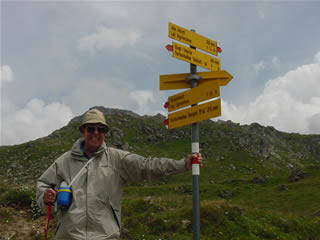 |
Harold Schiffman at the junction of trails to Alp Munt and Grialetsch. Upper Engadine, Switzerland (28 June 2003) |
| | | Home | | | Bio | | | Works | | | Incipits | | | Discography | | | Reviews | | | News | | | Links | | | Photos | | | Contact | | | Search | | |
Banner photo: Snowbird Mountains at dawn, Graham County, North Carolina (October 26, 2005) |